How much does NIST calibration cost?
NIST-traceable calibration costs vary based on equipment type, number of axes, measurement complexity, and service location. Sarkinen Calibrating provides detailed quotes after understanding your specific calibration needs. Our local Idaho presence often results in more competitive pricing than out-of-area providers due to reduced travel costs and faster response times.
What are the 5 requirements for calibration standard?
The five key requirements for calibration standards are: (1) Traceability to national or international standards like NIST, (2) Documented uncertainty of measurement, (3) Accuracy ratio of at least 10:1 compared to the equipment being calibrated, (4) Regular recalibration on a defined schedule, and (5) Proper storage and handling to maintain accuracy. Sarkinen Calibrating's equipment exceeds these requirements with measurements traceable to NIST and accuracy to 1.0 parts per million.
What is a performance calibration?
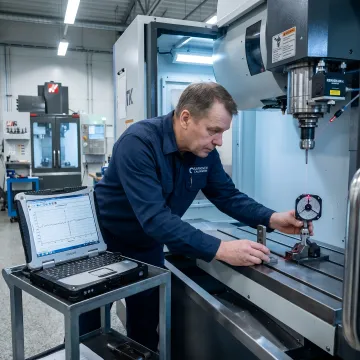
Performance calibration evaluates how well equipment operates under actual working conditions, not just static measurements. For CNC machines, this includes testing positioning accuracy, repeatability, straightness, squareness, backlash, and servo response across the full range of motion. Sarkinen Calibrating uses tools like laser interferometers and ballbar systems to assess real-world machine performance and identify issues affecting production quality.
How often should CNC machines be calibrated?
Most manufacturers calibrate CNC machines annually as a baseline preventive maintenance practice. However, calibration frequency should increase for high-precision work, heavy production schedules, machines showing accuracy drift, or after any significant maintenance, collision, or relocation. Sarkinen Calibrating can help establish a calibration schedule based on your specific production requirements and quality standards.
What equipment do you use for calibration services?
Sarkinen Calibrating uses industry-leading calibration equipment including Renishaw's Laser Interferometer for linear accuracy measurement, Renishaw's QC20-W Ballbar for circularity and machine health testing, Renishaw's Rotary Calibration System for multi-axis verification, and Mahr-Federal's Electronic Level for pitch and roll detection. All equipment provides NIST-traceable measurements with documented uncertainty.
Do you offer calibration services at our Idaho facility?
Yes, Sarkinen Calibrating provides on-site calibration services throughout Idaho. We bring all necessary equipment to your facility, minimizing machine downtime and eliminating the need to transport equipment. Our local presence in the Pacific Northwest ensures faster response times and more flexible scheduling compared to out-of-area calibration providers.
Can you verify that new machines meet manufacturer specifications?
Absolutely. Sarkinen Calibrating frequently performs acceptance testing on new CNC machines to verify they meet published specifications while still under warranty. Shipping and installation often introduce alignment errors or hidden damage that affect accuracy. Our NIST-traceable measurements provide documented proof of machine condition and help identify issues before they impact production or warranty coverage expires.
What documentation do you provide after calibration?
After each calibration, you receive a comprehensive report documenting all measurements, current machine condition, deviations from specifications, and NIST traceability statements. Reports include clear data visualization, specific recommendations for corrections or adjustments, and maintenance planning guidance. This documentation supports quality management systems, customer audits, and ISO compliance requirements.