What is basic maintenance in a CNC machine?
Basic CNC machine maintenance includes daily cleaning of chips and debris, lubrication of moving components, inspection of coolant levels, checking tool wear, and verifying that axes move smoothly. Beyond these routine tasks, periodic calibration ensures positioning accuracy, straightness, and squareness remain within specification. Regular ballbar testing and laser interferometer measurements identify wear patterns and alignment issues before they affect part quality.
What is a CNC maintenance technician?
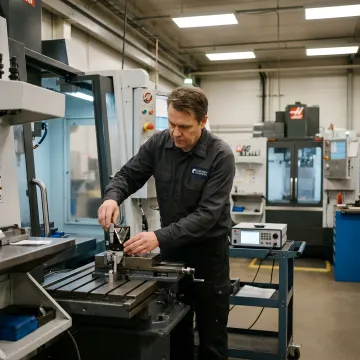
A CNC maintenance technician is responsible for keeping CNC machines operating accurately and reliably through preventive maintenance, troubleshooting, and calibration. They perform routine inspections, diagnose mechanical and electronic issues, calibrate axes using precision measurement equipment, replace worn components, and ensure machines meet performance specifications. Skilled technicians understand both the mechanical systems and control software that affect machine accuracy.
How often should CNC machines be calibrated?
Calibration frequency depends on machine usage, precision requirements, and part tolerances. High-precision operations may require quarterly calibration, while general machining might need annual verification. New machines should be calibrated after installation and before warranty expiration. Ballbar testing provides quick health checks between full calibrations. Any accuracy concerns, part quality issues, or after machine relocation warrant immediate calibration.
What is laser interferometer calibration?
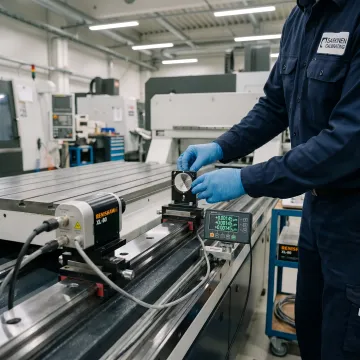
Laser interferometer calibration measures CNC machine positioning accuracy by comparing actual axis movement to commanded position using laser wavelengths as the reference. This provides accuracy to 1.0 parts per million—one millionth of an inch per inch—fully traceable to NIST standards. The system evaluates positioning accuracy, repeatability, straightness, and squareness across the machine's full travel range.
What is ballbar testing and why is it important?
Ballbar testing uses a telescoping precision bar to evaluate how accurately a CNC machine can follow a circular path. This quick test reveals circularity errors caused by backlash, servo mismatch, axis reversal problems, and squareness issues. It's one of the fastest ways to assess overall machine health, validate recent service work, and identify developing problems before they impact production quality.
Can you calibrate machines outside the Portland area?
Yes, while we primarily serve Portland OR and SW Washington with faster local response times, we also provide calibration services to customers outside our primary service area. Out-of-area service is available for facilities needing NIST-traceable precision calibration when local options are limited or when our specific expertise is required.
What accuracy can I expect from your calibration services?
Our Renishaw Laser Interferometer measurements achieve accuracy to 1.0 parts per million—equivalent to one millionth of an inch per inch of travel. This exceeds the 10:1 ratio required for proper calibration and meets or surpasses most machine tool manufacturer specifications. All measurements are fully traceable to NIST and International Standards with complete documentation.
Do you provide training on calibration equipment?
Yes, we offer hands-on training for Renishaw's Laser Interferometer and QC20-W Ballbar systems, covering proper setup, data collection, result interpretation, and troubleshooting. We also provide training on CAM software and CNC milling machine operation focused on how machine accuracy affects part quality. Training is tailored to your equipment and team's skill level.