How often should I have my CNC machines condition monitored?
Frequency depends on production volume, material hardness, and tolerance requirements. Most facilities benefit from annual monitoring as a baseline, with more frequent checks (quarterly or semi-annually) for high-volume production or tight-tolerance work. New equipment should be verified before warranty expiration, and any machine showing quality inconsistencies should be evaluated immediately.
What's the difference between ballbar testing and laser interferometry?
Ballbar testing provides a rapid overall health check by evaluating circular motion accuracy, identifying issues like backlash, servo problems, and squareness errors in 15-30 minutes. Laser interferometry offers detailed linear axis measurement—positioning accuracy, repeatability, straightness, and more—with NIST-traceable precision to 1.0 PPM. Ballbar is ideal for quick diagnostics and regular monitoring; laser interferometry for comprehensive accuracy verification and warranty validation.
Will condition monitoring disrupt my production schedule?
Most condition monitoring services are designed for minimal disruption. Ballbar testing typically takes 15-30 minutes per axis. Linear calibration requires 2-4 hours depending on axis count and travel length. We work with your production schedule to find convenient windows, often during shift changes, weekends, or planned downtime. The short-term scheduling investment prevents much longer unplanned outages from accuracy failures.
What results will I receive after condition monitoring?
You'll receive detailed reports documenting measured values, accuracy deviations, repeatability data, and comparisons to manufacturer specifications or industry standards. Reports include clear pass/fail indicators, graphical data representations, and actionable recommendations. All measurements include NIST traceability documentation. Results help you determine if corrective action is needed, validate recent service work, or confirm equipment is operating within specification.
Can condition monitoring identify problems before they cause part rejects?
Yes—that's the primary value. Condition monitoring detects gradual accuracy degradation, mechanical wear, and alignment drift long before they exceed tolerance thresholds. By establishing baseline measurements and tracking changes over time, you can schedule corrective maintenance during planned downtime rather than scrambling after parts fail inspection. Predictive data prevents scrap, reduces rework, and protects your quality reputation.
Do you provide condition monitoring services outside Portland and SW Washington?
Yes. While we serve Portland OR and SW Washington with faster response times than out-of-area providers, we also offer condition monitoring services to customers beyond this region. Contact us to discuss your location, equipment type, and scheduling needs. We'll work with you to provide the same NIST-traceable accuracy and comprehensive reporting regardless of location.
How do I know if my machine needs immediate condition monitoring?
Watch for warning signs: parts suddenly failing inspection that previously passed, increased scrap rates, inconsistent tolerances across production runs, or recent machine relocation/installation. New equipment should be verified before warranty expiration. If you've noticed any accuracy-related quality issues or want to establish performance baselines for preventive maintenance planning, condition monitoring provides the objective data you need.
What's included in the cost of condition monitoring services?
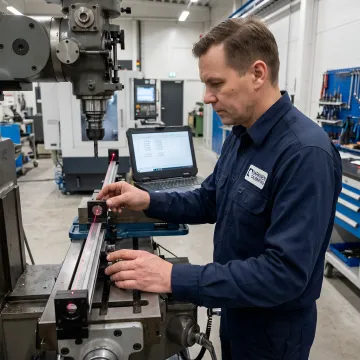
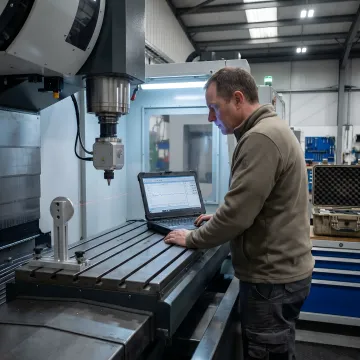
Service includes on-site measurement using calibrated equipment (laser interferometer, ballbar, electronic level, etc.), data collection and analysis, comprehensive reporting with NIST traceability documentation, and expert interpretation of results with actionable recommendations. Pricing varies based on equipment type, number of axes, and measurement complexity. Contact us for a detailed quote tailored to your specific monitoring needs.