What is the most accurate measurement tool?
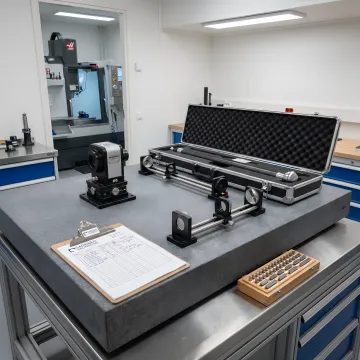
Laser interferometers provide the highest accuracy for linear measurement, with systems like Renishaw's achieving accuracy to 1.0 parts per million (one millionth of an inch per inch). These tools are traceable to NIST and international standards, making them ideal for verifying CNC machine positioning, straightness, and squareness with precision that exceeds required 10:1 calibration ratios.
What is the future of test and measurement?
The future of test and measurement focuses on wireless connectivity, real-time monitoring, predictive maintenance, and integration with Industry 4.0 systems. Equipment manufacturers are developing tools that provide instant feedback, automated data collection, and AI-assisted diagnostics to identify potential issues before they cause downtime, enabling proactive maintenance rather than reactive repairs.
Which manufacturers make the most reliable calibration equipment?
Renishaw and Mahr-Federal are recognized industry leaders for precision measurement and calibration equipment. Renishaw's laser interferometers and ballbar systems set standards for accuracy and repeatability, while Mahr-Federal's electronic levels provide precise angular measurement. Both manufacturers support NIST-traceable measurements and offer robust, field-proven systems trusted by quality-conscious manufacturing operations worldwide.
How often should CNC machines be calibrated with professional equipment?
Calibration frequency depends on machine usage, precision requirements, and production volume. High-precision operations typically calibrate annually or semi-annually, while machines producing critical aerospace or medical parts may require quarterly verification. New machines should be calibrated immediately after installation to verify they meet specifications while under warranty, and any time accuracy issues or unexpected part quality problems arise.
What's the difference between ballbar testing and laser interferometer calibration?
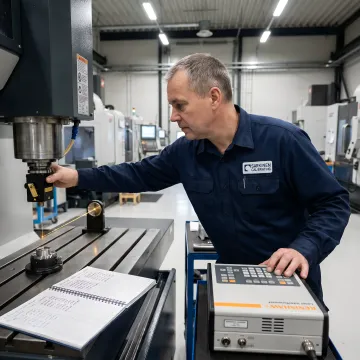
Ballbar testing provides a quick snapshot of overall machine health by evaluating circularity and identifying issues like backlash, servo mismatch, and squareness errors. Laser interferometer calibration offers detailed linear accuracy measurement across individual axes, measuring positioning, repeatability, straightness, and squareness with extreme precision. Ballbar tests are ideal for routine monitoring, while laser calibration provides comprehensive diagnostic data for troubleshooting and verification.
Can calibration equipment identify problems before machines fail?
Yes. Modern test and measurement equipment detects subtle changes in machine performance that indicate developing problems—worn bearings, loose components, encoder drift, or thermal issues—before they cause part rejects or catastrophic failure. Regular calibration establishes performance baselines and tracks trends over time, enabling predictive maintenance that prevents unexpected downtime and costly emergency repairs.
Do measurements need to be NIST-traceable for ISO certification?
Yes. ISO 9001 and industry-specific quality standards typically require calibration measurements traceable to national or international standards like NIST. This traceability provides documented proof that measurement equipment meets accuracy requirements and that calibration results are reliable, defensible, and recognized globally. Manufacturers supplying aerospace, medical, automotive, or defense industries face particularly strict traceability requirements.
What should I look for when selecting a calibration service provider?
Look for NIST-traceable measurements, equipment from recognized manufacturers like Renishaw or Mahr-Federal, experience with your specific machine types, local availability for faster response times, and technicians who understand production operations—not just calibration procedures. The best providers offer comprehensive solutions including troubleshooting, training, and actionable recommendations, not just data reports.