What does a calibration company do?
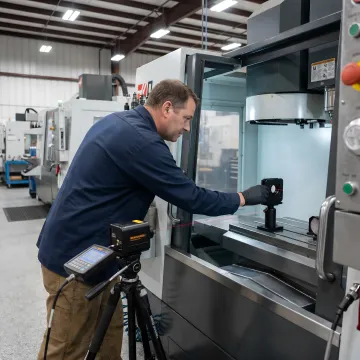
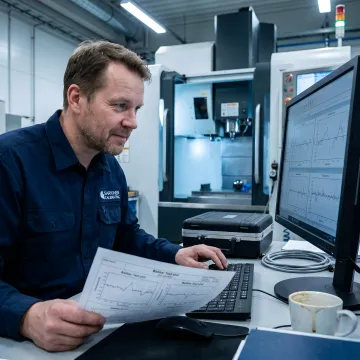
A calibration company verifies and adjusts the accuracy of precision equipment like CNC machines. Sarkinen Calibrating uses laser interferometry, ballbar testing, and electronic leveling to measure positioning accuracy, repeatability, straightness, and alignment. We provide NIST-traceable documentation showing whether your machine meets specifications and identify any accuracy issues affecting production quality. Calibration ensures your equipment produces parts to specification consistently and helps prevent unexpected downtime from undetected accuracy drift.
How often should CNC machines be calibrated?
Most manufacturers calibrate CNC machines annually, but frequency depends on production volume, part tolerances, and machine age. High-precision or high-volume operations may require semi-annual or quarterly calibration. New machines should be calibrated immediately after installation to verify manufacturer specifications while under warranty. We also recommend calibration after machine relocation, major repairs, or when part quality issues emerge. Regular calibration prevents small accuracy problems from becoming costly production failures.
What is NIST-traceable calibration and why does it matter?
NIST-traceable calibration means our measurements are linked through an unbroken chain of comparisons to standards maintained by the National Institute of Standards and Technology. This traceability provides legal defensibility, supports quality system compliance (ISO 9001, AS9100), and ensures accuracy claims are verifiable. Our measurements achieve 1.0 parts per million accuracy—well beyond the required 10:1 calibration ratio—giving you confidence that calibration results are reliable and your equipment truly meets specifications.
How long does machine calibration take?
Calibration time varies by machine size, complexity, and number of axes. A typical 3-axis CNC mill requires 4-6 hours for complete linear calibration. Ballbar testing is faster, often completed in 1-2 hours. Multi-axis machines with rotary tables take longer. We schedule calibration to minimize production disruption and can often work during maintenance windows or off-shifts. Our local Washington service area allows flexible scheduling and faster mobilization than out-of-area providers.
What causes CNC machines to lose accuracy over time?
Machine accuracy degrades from normal wear on ball screws, linear guides, and bearings. Thermal expansion from temperature changes, foundation settling, and mechanical loosening also contribute. Sudden impacts, crashes, or improper use accelerate accuracy loss. Even new machines often arrive with accuracy issues from shipping damage or installation errors. Regular calibration identifies these problems early, before they affect part quality or cause expensive scrap and rework.
Can calibration fix accuracy problems or just identify them?
Calibration primarily identifies and measures accuracy problems. Some issues like servo tuning, error compensation adjustments, or alignment corrections can be addressed during the calibration process. Mechanical problems such as worn ball screws, damaged bearings, or structural issues require repair before accuracy can be restored. Our reports provide clear recommendations for corrective action, including what can be adjusted versus what needs repair, helping you prioritize maintenance effectively.
Do you calibrate machines in Washington outside the Portland metro area?
Yes, we serve all of Washington and provide faster response times throughout SW Washington and the Portland OR area compared to out-of-area providers. We also have capabilities to help customers outside our primary service area when needed. Our local presence means we can respond quickly to urgent calibration needs, schedule follow-up visits efficiently, and provide ongoing support without the delays and travel costs associated with distant calibration providers.
What equipment and methods do you use for calibration?
We use Renishaw's Laser Interferometer system for linear calibration, providing accuracy to 1.0 parts per million. For machine condition monitoring, we employ the Renishaw QC20-W wireless Ballbar system. Rotary axis accuracy is measured with Renishaw's Rotary Calibration System. Surface plates are evaluated using Moody Plot flatness analysis. Machine leveling utilizes Mahr-Federal Electronic Levels. All methods meet or exceed industry standards and provide measurements traceable to NIST and International Standards.